Penyakit Infeksi: Aspek Laboratorium Influenza
From Molecular Virology to Clinical Decision Making

2026-08-11
Influenza
Learning Framework
1
Virus structure
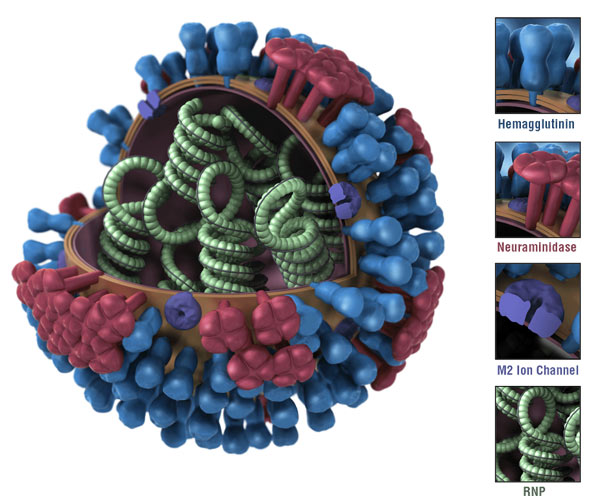
Menentukan fungsi HA, NA, M2, envelope, dan segmentasi genome.
2
Genome biology
Menjelaskan negative-sense RNA, 8 segmen, reassortment, antigenic drift/shift.
3
Replication cycle
Setiap tahap memberikan target diagnostik/farmakologis.
4
Host response
Menjelaskan mengapa pasien mengalami demam, myalgia, pneumonia, dan ARDS.
5
Clinical syndrome
Mengubah mekanisme menjadi diagnosis dan differential diagnosis.
6
Diagnosis
Menguji sensitivitas, spesifisitas, PCR, rapid test, dan clinical probability.
7
Treatment
Menghubungkan target molekuler dengan obat dan timing terapi.
8
Prevention
Menghubungkan antigenic evolution, immunity, vaksin, dan epidemiologi pandemi.
Why Influenza Remains Important?
A virus with two faces
Seasonal disease
- Recurrent outbreaks
- Moderate morbidity
Pandemic threat
- Novel antigenic combination
- Population susceptibility
Clinical Opening Case
The case
A 67-year-old man presents with:
- Fever 39°C
- Dry cough
- Fatigue & severe myalgia
Symptoms began 24 hours ago.
History:
- COPD
- No vaccination this year
Question:
What pathogen is most likely?
Sudden onset systemic illness
| Disease | Pattern |
|---|---|
| Influenza | Sudden |
| Common cold | Gradual |
| COVID-19 | Variable |
| Bacterial pneumonia | Progressive |
Virology Overview
Family: Orthomyxoviridae
Characteristics:
- Enveloped
- Negative sense RNA
- Segmented genome
Why Negative Sense RNA Matters
Negative RNA cannot directly function as mRNA.
Therefore virus must carry RNA-dependent RNA polymerase into the virion.
Olympiad Question 1
A researcher removes viral polymerase from influenza particles.
What process is immediately impaired?
A. Viral attachment
B. Genome transcription
C. Viral budding
D. Capsid assembly
Catatan
B. Genome transcription
Because:
(-)RNA genome cannot be translated directly.
The virus must synthesize:
(-)RNA → (+)mRNA
Influenza Genome
8 RNA segments:
Encode:
- HA
- NA
- M proteins
- Polymerase proteins
- Internal proteins
Why Segmented Genome Matters
Segmented genome allows:
Reassortment
Exchange of RNA segments between viruses.
Antigenic Shift Mechanism
Example:
Host:
Pig respiratory tract
contains:
- Human influenza virus
- Avian influenza virus
Co-infection occurs.
Olympiad Question 2
The emergence of a novel influenza subtype is most likely due to:
A. Point mutation in HA gene
B. Genome reassortment
C. DNA integration
D. Reverse transcriptase activity
Answer
B. Genome reassortment
This produces:
New HA/NA combination
→ little population immunity
→ pandemic risk
Influenza A Classification
Based on:
Hemagglutinin (H)
and
Neuraminidase (N)
Examples:
H1N1
H3N2
HA Function
Hemagglutinin mediates:
Virus attachment
by binding:
Sialic acid receptor
on respiratory epithelial cells.
Clinical Correlation
Antibodies against HA:
↓
Block viral entry
↓
Neutralizing antibodies
↓
Protection from infection

RMO & IMO